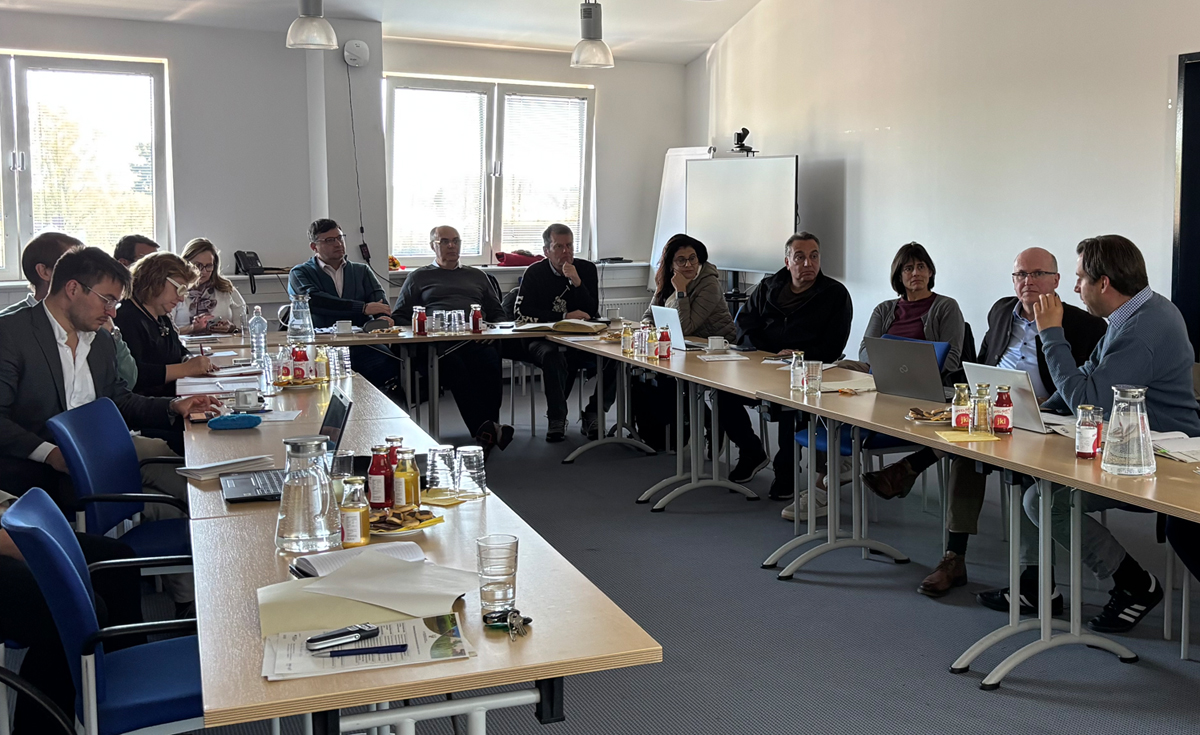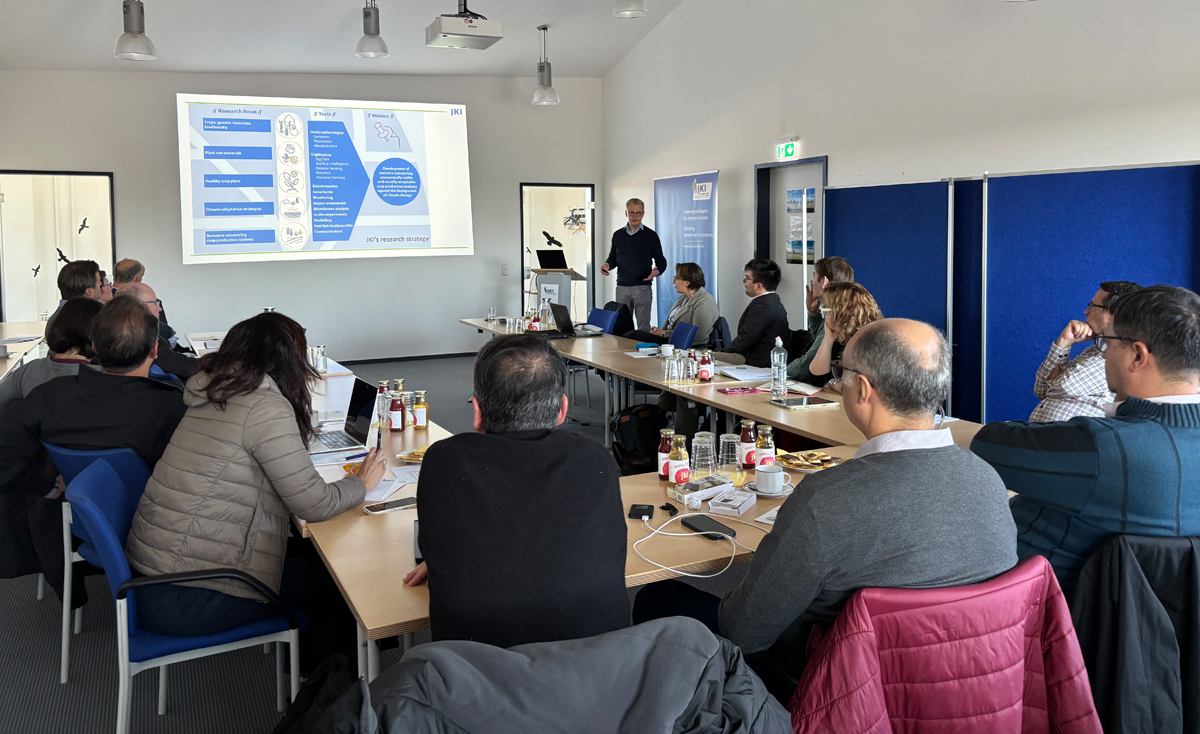
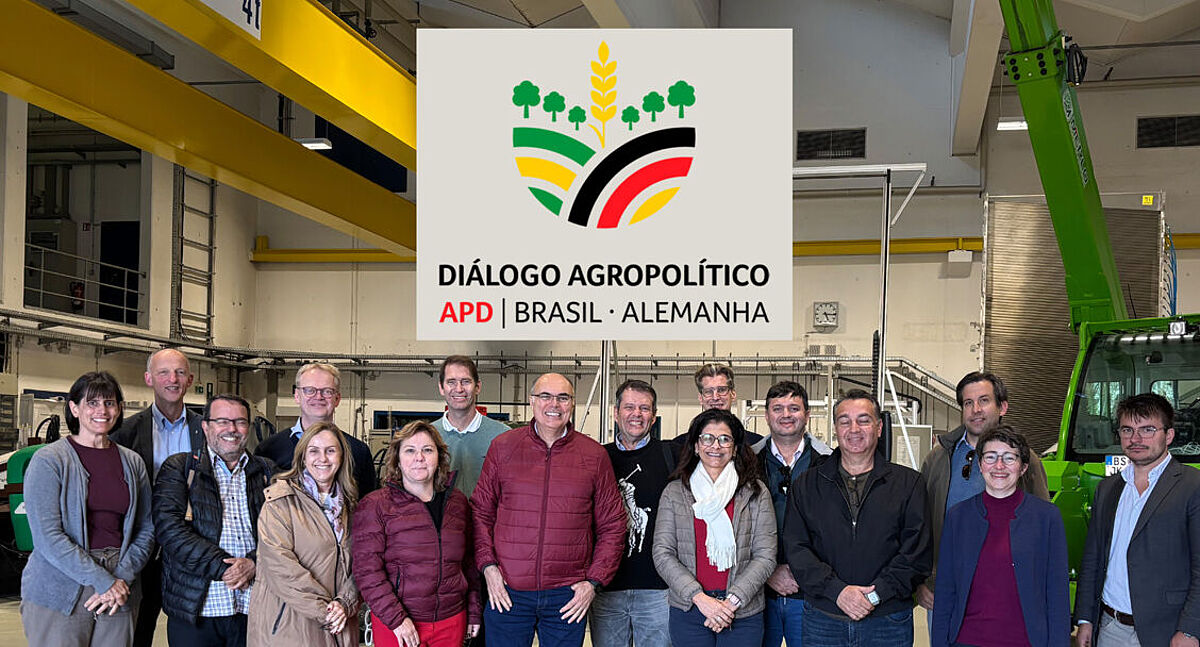
On 22 April, during the German-Brazilian Business Days in Hanover, a delegation from Brazil comprising representatives from the agricultural research institute Embrapa, the Ministry of Agriculture (MAPA) and the German-Brazilian Agricultural Policy Dialogue (APD) visited the Julius Kühn Institute (JKI) in Braunschweig.
As part of the German-Brazilian Agricultural Policy Dialogue (APD), a high-ranking delegation from Brazil visited Germany from April 20 to 24 at the invitation of the Federal Ministry of Agriculture, Food and Regional Identity (BMLEH). The seven delegates — representing the agricultural research institution Embrapa and the Brazilian Ministry of Agriculture (MAPA) — completed an extensive program in Berlin, Potsdam and Braunschweig. During their visit, they toured the Julius Kühn Institute (JKI), as well as the Thünen Institute and the Leibniz Institute German Collection of Microorganisms and Cell Cultures (DSMZ) who also are located in Braunschweig. Another stopp was the visit of the Leibniz Institute for Agricultural Engineering and Bioeconomy (ATB) in Potsdam. Furthermore, the delegates participated in exchange sessions at the Alexander von Humboldt Foundation and the German Institute for International and Security Affairs (SWP).
During their visit to JKI, the delegation gained insights into the research conducted at its Braunschweig location. Particular emphasis was placed on the following aspects:
- sustainable and climate-resilient plant production systems,
- healthy soils fostered through microorganism-assisted plant production,
- challenges facing the plant health system within an international context,
- research into the biology and ecology of pests and their control, and
- the technologies employed in the field of plant protection.
Furthermore, discussions covered cross-cutting themes such as digitalization in agriculture as well as the transfer of research findings into practical application.
During a concluding discussion, all participants deliberated on which urgent topics of mutual importance should receive particular attention in the coming years — on the one hand’s side with regard to the existing cooperation agreements between JKI and Embrapa, and between BMLEH and MAPA, and on the other hand’s side in the context of the German-Brazilian Agricultural Policy Dialogue and the MERCOSUR trade agreement concluded between the EU and South American states.
Priority topics identified in this regard include, above all, the influence of the microbiome on soil health, the registration processes for bioinputs — specifically biological plant protection products and biostimulants — as well as the monitoring of plant protection product applications, the reduction of the use of chemical-synthetic plant protection products, and the use of bees as indicators in agriculture. As the leading national institutions in these fields, JKI and Embrapa will pursue these topics in the future under the umbrella of the APD.