

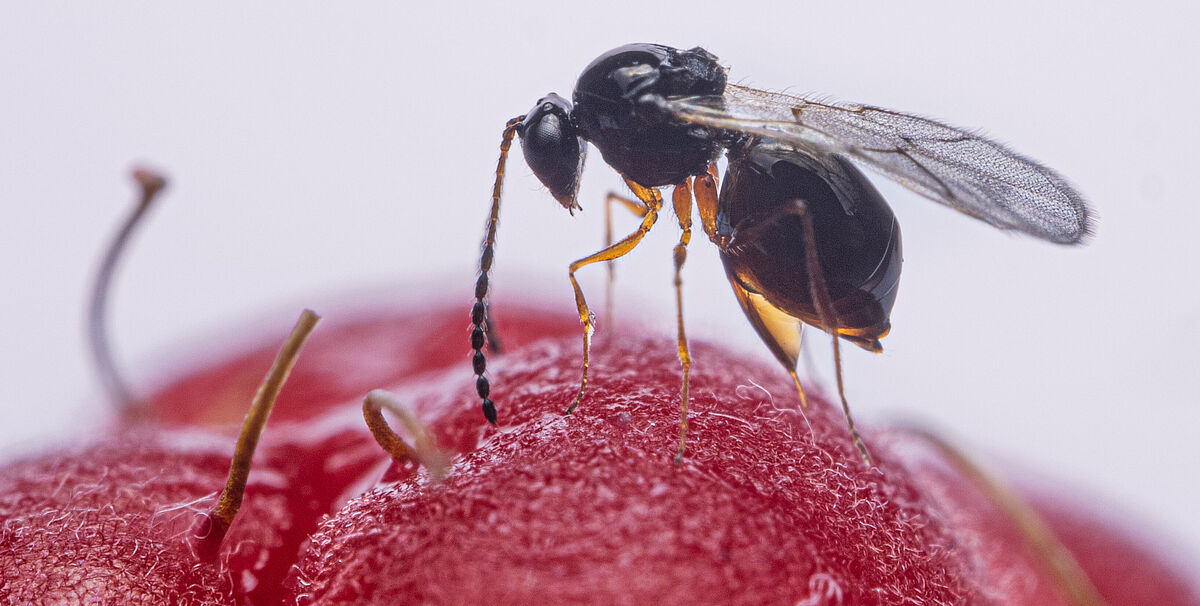
This study used dynamic temperature and humidity simulations to investigate whether the parasitic wasp Leptopilina japonica develops better under early summer or late summer conditions. The parasitic wasp is an important natural enemy of the spotted wing drosophila (Drosophila suzukii) – the periods ‘early summer’ and ‘late summer’ are important for biological plant protection, as they mark the start and peak, respectively, of spotted wing drosophila’s population growth. It is therefore important to be able to assess the performance of natural enemies at these times.
A mixed result was observed: The development rate of the offspring was much faster under the warm early summer conditions, albeit at the expense of a short lifespan and a relatively low reproduction rate. In contrast, mating success and the number of offspring were better under the cooler temperatures of late summer, whilst the development rate was slower. The results were compared with standard laboratory conditions. Compared to ‘late summer’, the individual results differed, in some cases considerably. Our study helps to better understand the population dynamics of the L. japonica in the field.
The recently published paper is based on the results of the Master’s thesis by Juliet Aranibar Luna, which was written at the JKI – Institute for Biological Plant Protection.
Martin, J., Aranibar Luna, J. D., Herz, A. (2026) Performance of Leptopilina japonica Novković and Kimura (Hymenoptera: Figitidae) Under Fluctuating Temperature and Humidity. Entomologia Experimentalis et Applicata, Special issue: 8th International Entomophagous Insects Conference.